
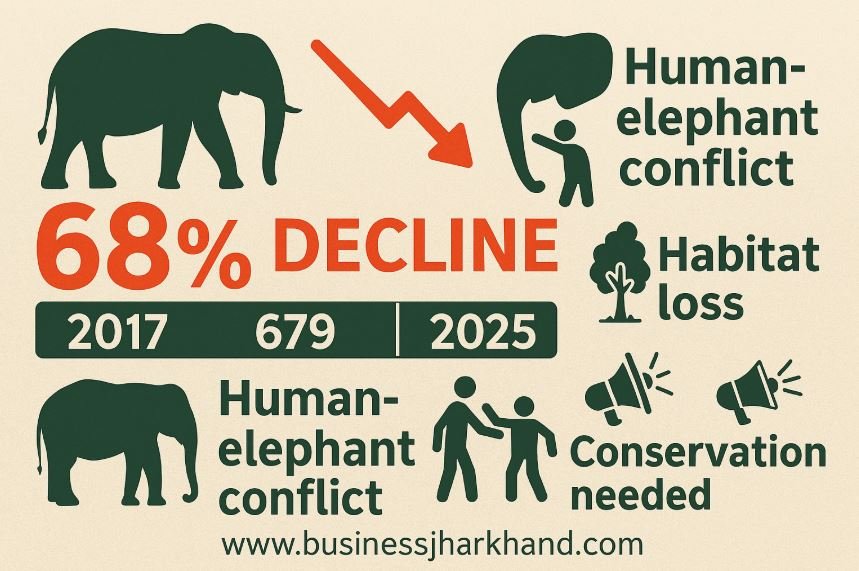
Jharkhand has witnessed a drastic 68% decline in its wild elephant population, according to India’s first DNA-based elephant census, conducted jointly by the Ministry of Environment, Project Elephant, and the Wildlife Institute of India. The study, titled All India Synchronous Elephant Estimation (SAIEE) 2025, found that elephant numbers in the State have dropped from 679 in 2017 to just 217 in 2025, raising alarm among conservationists and wildlife officials.
Also Read: Damodar Valley, Once India’s Ruhr, Now Looking to Green Future
Human-Elephant Conflict and Habitat Loss Behind the Crisis
Jharkhand’s once-thriving elephant zones, including the Chotanagpur plateau, Palamu, Singhbhum, and Dhalbhum have shrunk due to human encroachment, deforestation, and infrastructure expansion. Experts said elephants are now confined to fragmented patches of forest, forcing them to move through farmlands and human settlements in search of food and water. Between 2005 and 2014, elephant attacks claimed 576 human lives, with the Ranchi forest division alone reporting 89 deaths. At the same time, 30 elephants died between 2004 and 2017 due to disease, electrocution, poaching, poisoning, and train accidents. Recent data show that nearly 90% of human fatalities occurred outside forest zones, reflecting the extent of habitat intrusion.
Also Read: Coal India Focused on Green Jobs, Reclaimed 38,000 Hectares of Mined Land
Also Read: CMPDI Expanded CSR Portfolio, Added Green Energy and Health Projects
Experts Urged Immediate Conservation Measures
Wildlife researchers have termed the figures “deeply concerning”, calling for urgent steps to restore forest corridors and manage human-elephant interfaces. Jharkhand, with 31.5% forest cover (around 25,000 sq km), has traditionally served as a vital link in Central India’s elephant migration route. However, rapid land-use changes have disrupted these paths, pushing elephants into conflict-prone zones.
Also Read: Jharkhand Government and CEED released ‘Powering Progress’, a High Level Study on Renewable Energy
Wider Decline Across Eastern India Raises Concern
The report also recorded severe population drops in neighbouring states, West Bengal (84%) and Odisha (54%) with an overall 41% decline across the Central and Eastern Ghats region. Though the Environment Ministry noted that the new DNA sampling and mark recapture method cannot be directly compared with older surveys, it acknowledged that the data form a crucial new baseline for long-term monitoring. Conservationists have urged the Centre to enhance Project Elephant funding and adopt community based conflict mitigation models. Without immediate and coordinated action, they warned, Jharkhand’s elephants could face a grave threat to their survival.
Also Read: Jharkhand Cabinet Approved 24 Key Proposals
Join the WhatsApp Group of Business Jharkhand to Stay tuned for all the latest updates of industrial-political developments in Jharkhand.
You May Also Like

Labour Code Introduced Stricter Rules on Salary Payments and Employee Settlements

Jharkhand Cabinet Cleared Higher Cess Rates on Mineral-Bearing Land, Notification Issued