
For millions of Hindu families, a journey to Gayaji during Pitripaksh is about remembering ancestors and performing rituals for their peace and salvation. For Gayaji’s economy, however, the annual pilgrimage is also the biggest business season of the year.
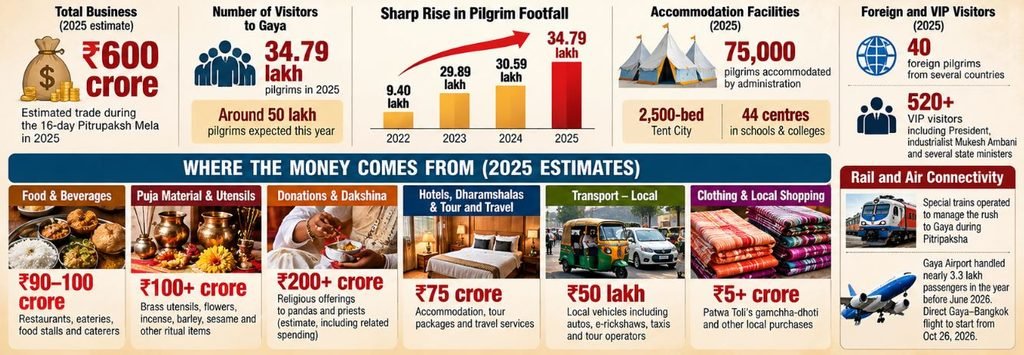
As Pitripaksh begins in Gayaji, the city is preparing for another massive influx of pilgrims. The scale of the market can be understood from last year’s numbers. In 2025, local traders estimated that the 16 days Pitripaksh fair generated business of around Rs. 600 crore, covering religious offerings, food, accommodation, transport, donations and a range of small purchases made by pilgrims. The figure was a trade estimate rather than an official Government calculation.
This year, the potential market is even larger. The number of visitors to Gayaji during Pitripaksh has risen sharply over the past four years, from 9.40 lakh in 2022 to 29.89 lakh in 2023, 30.59 lakh in 2024 and 34.79 lakh in 2025. The administration and tourism authorities are preparing for around 50 lakh visitors this year.
Also Read: Today’s Headlines – Business Jharkhand
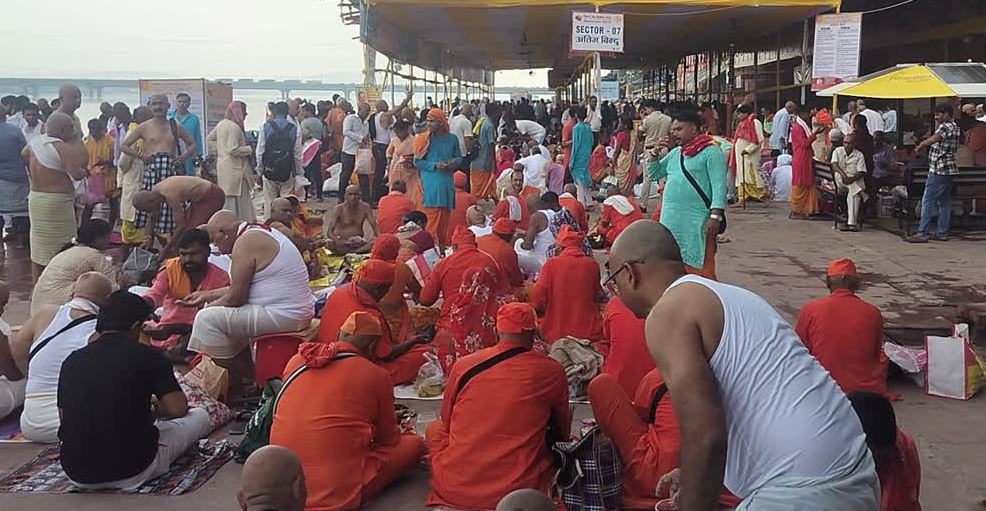
Why Gayaji Matters During Pitripaksh
Pitripaksh is a period in the Hindu calendar dedicated to performing Shraddha, Tarpan and Pind Daan for departed ancestors. Gayaji has a special place in this tradition. Rituals are performed at sacred locations including the Phalgu River, Vishnupad Temple and Akshay Vat, making the city one of the country’s most important destinations for ancestral rites. The Ministry of Tourism describes Pitripaksh as a 16 days period devoted to paying homage to ancestors, with Pind Daan and related rituals forming the central practice.
Religious belief is the foundation of the Gayaji pilgrimage, but the economic activity around it is remarkably broad. A family arriving for Pind Daan does not spend only on the ritual. It needs a place to stay, food, local transport, puja material, clothing and other household items. Many families also hire priests, vehicles and guides and visit other religious and tourist locations around Gayaji and Bodh Gaya.
That creates a temporary economy involving thousands of people, from hotels and restaurants to flower sellers, utensil shops, priests, auto and e-rickshaw drivers, taxi operators, tour agencies, local artisans and small roadside vendors.
Rs. 600 Crore Was the 2025 Business Benchmark
The most useful indication of the scale of the Pitripaksh market comes from the 2025 fair. Local business representatives estimated the overall business at around Rs. 600 crore. The estimate included several streams of spending and was not based on an official Government audit.
Among the biggest individual segments was food. Local business representatives estimated that pilgrims spent around Rs. 90 to 100 crore on food during the 2025 fair. Restaurants, small eateries, roadside food stalls, sweet shops, caterers and vendors all benefited from the large daily footfall.
The puja material and utensil trade was estimated at more than Rs. 100 crore. This includes items used for Pind Daan and Shraddha rituals, along with utensils purchased by visiting families. Demand rises for barley flour, sesame, flowers, incense sticks, earthen lamps and other ritual items. Brass utensils are also popular. In 2025, local traders reported brass prices of roughly Rs. 700 to 900 per kg.
The religious economy does not end at the shops. Panda priests and Pandits play a central role in organising and conducting the rituals. Their services include arranging Pind Daan at different vedis, performing rituals and guiding families through the prescribed ceremonies. Dakshina and other religious payments form another important part of the seasonal economy. Local trade estimates put the combined value of food, puja-related purchases and donations or dakshina at more than Rs. 200 crore, though there is no official item-wise accounting.
Also Read: A Spiritual Phenomenon Transformed into India’s Biggest Economic Event
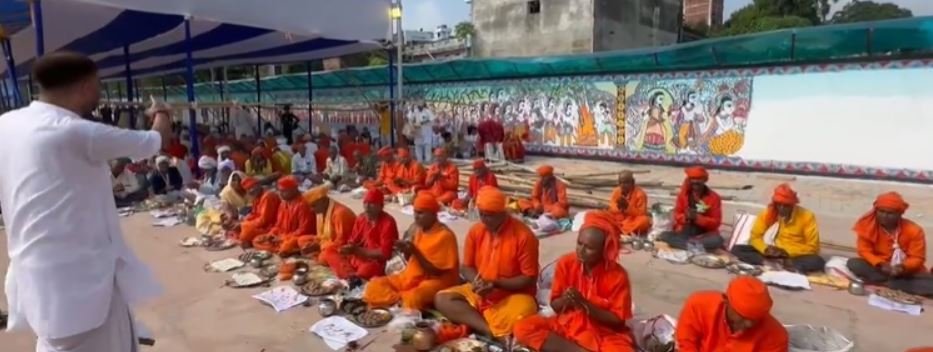
Hotels, Dharamshalas and Food Businesses Get a Seasonal Windfall
Accommodation is another major component of the Pitripkash economy. Hotels, guest houses, lodges and dharamshalas see their demand rise sharply during the 16 days period.
In 2025, the local hotel industry and tour-and-travel sector together estimated business of around Rs. 75 crore. The hotel figure was lower than what the industry had expected because a sizeable number of pilgrims stayed in dharamshalas and Government arranged accommodation instead of commercial hotels.
The nature of the demand is also different from ordinary tourism. Families often travel together, with several members staying for the duration of the rituals. Some stay for a day, while others remain for several days depending on their ritual schedule.
This year, the accommodation ecosystem has been expanded to handle the expected rise in visitors. Reports say 44 accommodation centres in schools and colleges have been arranged for around 70,000 pilgrims, while additional temporary accommodation and tent facilities are also being created.
The State Tourism Department has also been promoting organised pilgrimage packages combining transport, accommodation, food and Pind Daan related services. Current Bihar tourism packages show how the pilgrimage has developed into a structured travel market, with one-day and two days packages covering Gayaji, Punpun, Bodh Gaya, Rajgir and Nalanda.
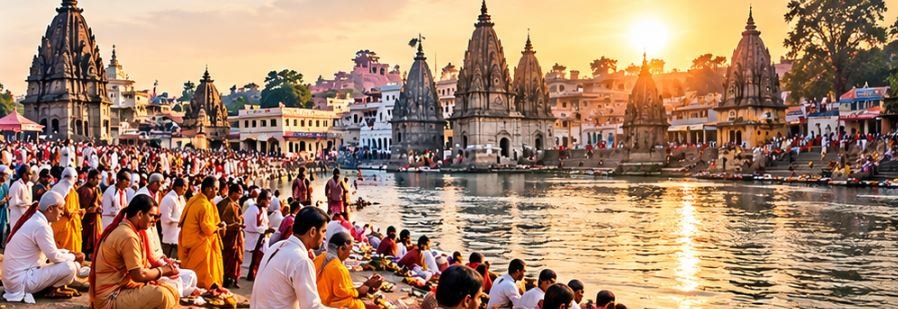
Rail, Road, Auto and Taxi, Another Big Spending Chain
The economic impact begins even before pilgrims reach Gayaji. For a family travelling from another state, the journey may involve a train ticket, bus or private car, followed by an auto, e-rickshaw or taxi in Gayaji. The city sees a sharp rise in demand for local vehicles during the fair.
Railways also operate special trains to deal with the seasonal rush. In 2025, special services were operated from Rani Kamalapati, Jabalpur and Sogaria or Kota to Gayaji. For 2026, special trains have again been announced from Rani Kamalapati and Jabalpur. Gayaji railway station has also been preparing additional ticketing facilities for the pilgrimage season.
There is, however, no reliable public figure showing how much pilgrims collectively spend on railway and bus fares for the Gayaji pilgrimage. Similarly, the Rs. 50 lakh transport figure reported in 2025 referred to local transportation business, rather than the total amount spent by pilgrims on rail, bus, taxi and private vehicles. It would therefore be misleading to treat it as the complete transport market.
Air travel forms a smaller but important part of the market. Gayaji Airport handled nearly 3.3 lakh passengers over the year preceding June 2026, according to its airport director. Domestic connectivity is available to Delhi and Kolkata, while international traffic is seasonal.
The airport is also likely to become more important for international religious tourism. IndiGo has announced a direct Gayaji to Bangkok service from 26th October 2026, although that begins after this year’s Pitripaksh period.
Gayaji’s Pitripkash Economy at a Glance
| Category | Reported/Indicative 2025 Figure |
| Visitors | Rs. 34.79 lakh |
| Local trade estimate | ~Rs. 600 crore |
| Food business | Rs. 90–100 crore |
| Puja material & utensils | Rs. 100+ crore |
| Hotel + tour & travel | ~Rs. 75 crore |
| Patwa Toli clothing | Rs. 5+ crore |
| Local transport | ~Rs. 50 lakh |
| 2026 expected visitors | ~Rs. 50 lakh |
| Indicative market at 2025 per-visitor spending | ~Rs. 860 crore* |
From Gamchha to Ghee, the Small Shops Also Matter
The Pitripaksh economy is not limited to large businesses. Its strength lies in thousands of small transactions. A pilgrim may buy a gamchha, dhoti, utensils, flowers, fruits, incense, earthen lamps, grains, religious books or other ritual articles. The Patwa Toli market, known for its traditional gamchha and dhoti trade, recorded sales of more than Rs. 5 crore during the 2025 fair, according to local estimates.
Street vendors, florists, sweet shops, grocery stores and small eateries also benefit. Temporary workers are hired for cleaning, loading, catering, transport and other services. For many small traders, the 16 days period can account for a substantial share of their annual seasonal income.
This is why the Pitripaksh market is better understood not as a single industry but as a local economic chain. Money spent by a pilgrim at a hotels, taxi drivers, food suppliers, puja shops and other small vendors and manufacturers moves to its employees and suppliers outside Gayaji as well.
What Could the 2026 Market Look Like?
The 2025 estimate of Rs. 600 crore provides a useful benchmark, but it should not be treated as a guaranteed figure for 2026. If the same average spending pattern were simply applied to the 50 lakh visitors expected this year, the implied economic activity would be around Rs. 860 crore. This is only a mathematical indication, not a forecast. Actual spending will depend on how many visitors stay overnight, how long they remain in the city, how many use commercial hotels, how much they spend on rituals and food, and how much accommodation is provided through dharamshalas and the other Government facilities.
The calculation nevertheless shows why Gayaji’s Pitripaksh has become an important economic event for Bihar. At last year’s estimated Rs. 600 crore and 34.79 lakh visitors, the implied average economic activity was roughly Rs. 1,725 per visitor. With 50 lakh visitors, even a similar per person spending pattern would create a market approaching Rs. 860 crore.
The larger story is therefore not just about the money changing hands during a religious festival. Gayaji’s Pitripaksh shown that how faith, tourism, hospitality, transport, traditional occupations and small commerce come together to create a large seasonal economy.
For Gayaji, the challenge now is to convert this annual surge into a more organised and sustainable tourism ecosystem, where any pilgrims get better facilities, local businesses get predictable opportunities and the city benefits from the economic value generated by one of India’s most enduring pilgrimage traditions.
Also Read: Jamtara Displaced People Threatened DVC Gate Blockade Over Land and Rehabilitation
Our Readers can share their feedback or suggestions on our news and articles with us. Please send them via WhatsApp only at +918210780320.
You May Also Like

Security Operations Ended Two Decade Run of Maoist Groups in Jharkhand
Veteran Tribal Leader and JMM founder Shibu Soren Passed Away at 81. Jharkhand Government declared a three-day state mourning from 4th August 2025.