Coal India’s permanent workforce has fallen sharply over the past five decades even as the company’s coal production has increased several times. From around 7.5 lakh employees at the time of coal industry nationalisation in 1975, the workforce has now declined to 2,08,616, according to the company’s August 2026 manpower report released on 14th September 2026.
Also Read: Today’s Headlines – Business Jharkhand
The decline has continued during the current financial year. Coal India had 2,12,066 employees at the beginning of FY 2026-27, but the number fell by 3,450 in five months. Among its subsidiaries, ECL recorded the highest decline of 1,045 employees, followed by SECL with 754 and BCCL with 620. The figures come at a time when the company is targeting 814.85 million tonnes (MT) of coal production this financial year. Its cumulative production had reached 297.07 MT by 17th September 2026.
Also Read: Coal India Introduced New CSR Framework, Made 80% Spending Mandatory in Mining Affected Areas
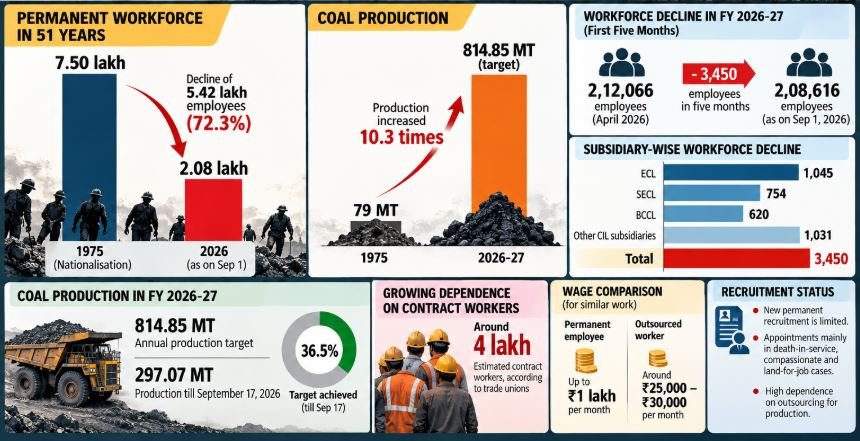
The contrast is sharper when the figures from 1975 are compared with the present. Coal India’s production was around 79 MT in 1975, when it had about 7.5 lakh employees. The company’s current annual production target is more than ten times that level, while its permanent workforce is less than one-third of what it was then. The decline has been linked to retirements, mechanisation and automation, along with limited fresh recruitment and greater use of outsourcing agencies. At present, permanent appointments are largely being made in death in service, compassionate appointment and land for job cases, according to the report.
Also Read: Supreme Court Ruled that Principal Employer Cannot Be Made Liable for Gratuity Payable
The fall in permanent employment has coincided with a growing dependence on contract workers for mining operations. Trade unions estimate that the number of contract workers engaged through outsourcing agencies has reached around four lakh, though the figure is not officially disclosed in the report. Union representatives say there is a substantial difference between the wages and benefits available to permanent employees and those doing similar work through outsourcing agencies. BMS leader Bindeshwari Prasad said the lack of regular recruitment was a concern and that continued reliance on outsourcing could further reduce permanent employment and raise questions over workers’ social security.